
Basic Self-employed Contract For Services
“`html
Basic Self-Employed Contract for Services
This document outlines the fundamental elements of a contract for services between a client and a self-employed individual (the “Contractor”). It is crucial to remember that this is a simplified overview and professional legal advice should always be sought to tailor a contract to specific circumstances.
Key Elements of a Contract for Services
A valid contract requires several core components. These elements ensure clarity, protect both parties, and provide a framework for a successful working relationship.
1. Identification of Parties
Clearly identify both the client and the Contractor. This includes:
*
Client: Full legal name (e.g., company name if a business), address, and contact information.
*
Contractor: Full legal name, business name (if applicable), address, and contact information.
State that the Contractor is operating as an independent contractor and not an employee of the client. This is crucial for determining legal obligations regarding taxes, benefits, and liability.
2. Scope of Services
Define the specific services the Contractor will provide in detail. Avoid vague language. Use clear and concise descriptions. Examples:
*
Instead of “Marketing Services,” specify “Creation of five social media posts per week, management of online advertising campaigns with a budget of $X, and monthly performance reports.”
*
Instead of “Consulting Services,” specify “Provide a written report outlining strategies for improving customer retention within 30 days.”
Clearly state what is *not* included in the scope of services to prevent misunderstandings.
3. Term and Termination
Define the duration of the contract. Options include:
*
Fixed Term: A specific start and end date.
*
Ongoing: Continues until terminated by either party.
Project-Based: Ends upon completion of the defined project.Outline the conditions under which either party can terminate the contract. Common provisions include:
*
Notice Period: The amount of advance notice required for termination (e.g., 30 days’ written notice).
*
Termination for Cause: Reasons for immediate termination due to breach of contract (e.g., failure to perform services, non-payment).
*
Termination for Convenience: Allows either party to terminate the contract without cause, subject to the notice period.
4. Compensation and Payment Terms
Specify the total compensation the Contractor will receive. Common payment structures include:
*
Fixed Fee: A set amount for the entire project or service.
*
Hourly Rate: Payment based on the number of hours worked.
*
Project Milestones: Payments tied to the completion of specific project milestones.
*
Retainer: A recurring payment for ongoing access to the Contractor’s services.
Clearly define:
*
The payment schedule (e.g., weekly, bi-weekly, monthly, upon invoice).
*
The method of payment (e.g., check, electronic transfer, online payment platform).
*
Late payment penalties, if any.
*
Expense reimbursement policy (e.g., whether the Contractor will be reimbursed for travel expenses, materials, etc.). State the method of providing receipts.
5. Independent Contractor Status
Reinforce that the Contractor is an independent contractor and not an employee. This section should explicitly state that the Contractor is responsible for:
*
Paying their own taxes (including self-employment tax).
*
Obtaining their own insurance (e.g., liability insurance).
*
Providing their own tools and equipment.
*
Controlling the manner and means by which the services are performed (subject to meeting the client’s requirements for the deliverable).
The client should not exercise excessive control over the Contractor’s work, as this could lead to misclassification as an employee.
6. Intellectual Property
Determine ownership of intellectual property created during the contract. Common options include:
*
Client Ownership: All intellectual property created by the Contractor belongs to the client (“Work Made for Hire”).
*
Contractor Ownership: The Contractor retains ownership of the intellectual property.
*
Joint Ownership: Both the client and the Contractor share ownership.
Specify the terms of use for each party. This is especially important if the Contractor is using pre-existing intellectual property.
7. Confidentiality
Protect confidential information shared between the client and the Contractor. This section should define:
*
What constitutes confidential information (e.g., trade secrets, customer lists, financial data).
*
The obligations of both parties to protect confidential information.
*
The duration of the confidentiality obligation (e.g., during the contract and for a specified period after termination).
8. Limitation of Liability
Limit the financial liability of each party in case of breach of contract or negligence. This is typically a negotiated clause that specifies the maximum amount of damages one party can recover from the other.
It is crucial to understand the legal implications of a limitation of liability clause and seek legal advice.
9. Governing Law and Dispute Resolution
Specify the state or jurisdiction whose laws will govern the contract. This helps to ensure predictability and consistency in legal interpretation.
Outline the process for resolving disputes. Options include:
*
Negotiation: Parties attempt to resolve the dispute through informal discussions.
*
Mediation: A neutral third party helps the parties reach a settlement.
*
Arbitration: A neutral third party makes a binding decision.
*
Litigation: Filing a lawsuit in court.
10. Entire Agreement
This clause states that the written contract constitutes the entire agreement between the parties and supersedes all prior agreements or understandings, whether oral or written. This prevents disputes based on undocumented promises.
11. Severability
If any provision of the contract is found to be invalid or unenforceable, the remaining provisions will still be valid and enforceable.
12. Amendments
Specify that any changes to the contract must be in writing and signed by both parties.
13. Signatures
The contract must be signed and dated by both the client and the Contractor to be legally binding.
Important Considerations
*
State and Federal Laws: Ensure the contract complies with all applicable state and federal laws regarding independent contractors, taxation, and intellectual property.
*
Consultation with Professionals: This is a simplified overview. Always consult with an attorney and accountant to create a contract tailored to your specific needs and circumstances.
*
Negotiation: Contracts are often subject to negotiation. Be prepared to discuss and modify the terms to reach a mutually agreeable agreement.
By addressing these key elements, you can create a basic self-employed contract for services that provides a solid foundation for a successful working relationship. However, always seek professional legal and financial advice before entering into any contractual agreement.
“`
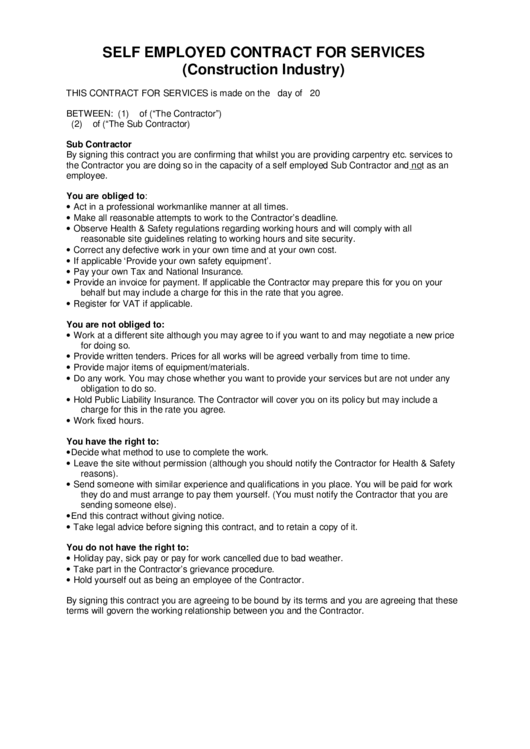 474×669 employed carpenter contract services printable from www.formsbank.com
  920×554 employed driver contract template templates resume examples from www.thesecularparent.com
  792×639 employed contract services template legal stop from www.thelegalstop.co.uk
  827×1170 employed contract template bonsai from www.hellobonsai.com
  700×400 employed carer contract template templates resume examples from www.thesecularparent.com
 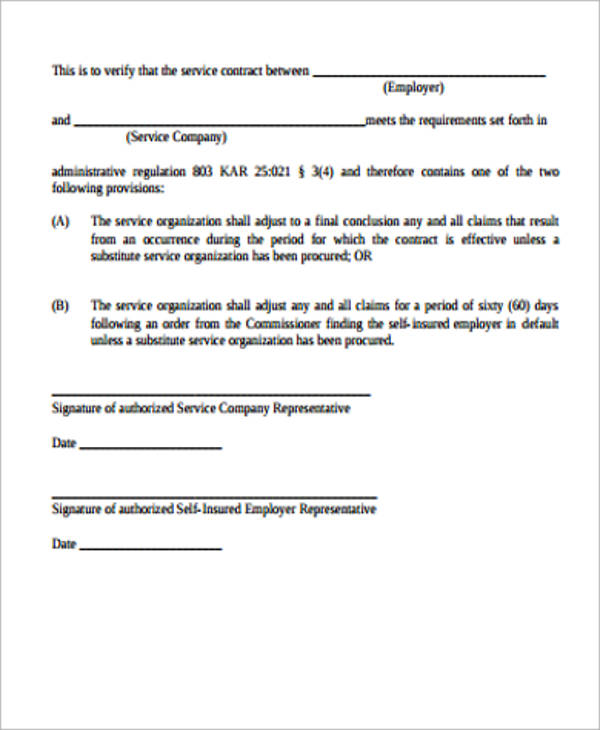 600×730 simple service contract samples ms word google docs from www.sampletemplates.com
  1354×1742 employment contract template sampletemplatess sampletemplatess from www.sampletemplatess.com
  600×730 employed contract template tutoreorg master documents from tutore.org
  390×475 employment contract samples ms word excel from www.sampletemplates.com
  1275×1650 employment contract from untukindokuo.blogspot.com