
How To Calculate Percentage Difference In Excel
Okay, here’s an HTML formatted explanation of how to calculate percentage difference in Excel, aiming for around 1000 words. “`html
Calculating Percentage Difference in Excel
Excel is a powerful tool for data analysis, and calculating percentage difference is a common task. Whether you’re comparing sales figures year-over-year, analyzing changes in website traffic, or evaluating the impact of marketing campaigns, understanding how to calculate percentage difference effectively in Excel is crucial. This guide will walk you through various scenarios and methods, ensuring you can confidently perform these calculations.
Understanding Percentage Difference
Percentage difference measures the relative change between two values. It essentially tells you how much one value has increased or decreased compared to another, expressed as a percentage. The formula for percentage difference is:
Percentage Difference = ((New Value – Old Value) / Old Value) * 100
Let’s break down the components:
- New Value: The value you’re comparing to the original value (e.g., sales in the current year).
- Old Value: The original or base value you’re using as a reference point (e.g., sales in the previous year).
- (New Value – Old Value): This calculates the absolute difference between the two values.
- (New Value – Old Value) / Old Value: This calculates the relative change or the difference as a fraction of the original value.
- * 100: This converts the relative change into a percentage.
Calculating Percentage Difference in Excel: Step-by-Step
Here’s how to apply this formula in Excel with practical examples.
Basic Percentage Difference Calculation
- Prepare Your Data:
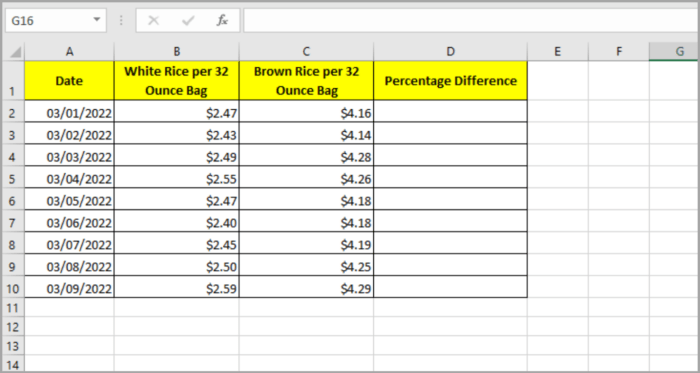
First, organize your data in an Excel sheet. You’ll typically have two columns: one for the “Old Value” and another for the “New Value.” For example:
Old Value (Year 1) New Value (Year 2) 100 120 150 135 200 250 - Enter the Formula:
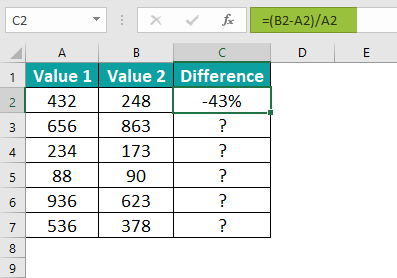
In a third column (e.g., “Percentage Difference”), enter the formula in the first cell (e.g., C2) corresponding to your first data row. Assuming your “Old Value” is in column A (A2) and your “New Value” is in column B (B2), the formula would be:
=(B2-A2)/A2*100This formula subtracts the value in cell A2 from the value in cell B2, divides the result by the value in cell A2, and then multiplies by 100 to express the result as a percentage.
- Format as Percentage:
Select the cell (C2) where you entered the formula. On the “Home” tab, in the “Number” group, click the “%” button (Percentage Style). This will format the cell to display the result as a percentage. You can also adjust the number of decimal places displayed using the “Increase Decimal” and “Decrease Decimal” buttons.
- Apply the Formula to the Remaining Rows:
Click on the bottom-right corner of the cell C2 (the small square, also known as the “fill handle”). Drag the fill handle down to apply the formula to the remaining rows in your data. Excel will automatically adjust the cell references (A2, B2) to correspond to each row (e.g., A3, B3, A4, B4, and so on).
Handling Zero Values in the Old Value Column
A common issue arises when the “Old Value” is zero. Dividing by zero results in an error (#DIV/0!) in Excel. To handle this, you can use the IF function.
The IF function allows you to specify a condition and return different results based on whether the condition is true or false. In this case, you can check if the “Old Value” is zero. If it is, you can return a specific value (e.g., 0, or “N/A” to indicate “Not Applicable”). If it’s not zero, you proceed with the percentage difference calculation.
Here’s the modified formula:
=IF(A2=0, "N/A", (B2-A2)/A2*100)
Explanation:
IF(A2=0, "N/A", ...): This checks if the value in cell A2 is equal to 0."N/A": If A2 is 0, the formula returns the text “N/A”. You can replace this with any value or text you prefer (e.g., 0, “Undefined”).(B2-A2)/A2*100: If A2 is not 0, the formula proceeds with the standard percentage difference calculation.
Handling Negative Values
The standard percentage difference formula works correctly even with negative values. Excel will handle the calculations appropriately, indicating whether there’s a negative or positive change. However, consider what a negative value in the “Old Value” column represents. The interpretation of the percentage difference might need careful consideration depending on the context of your data.
Calculating Percentage Increase/Decrease
While percentage difference is the general term, you might specifically want to highlight whether the change is an increase or a decrease. You can use conditional formatting to visually represent increases and decreases differently.
- Select the Percentage Difference Column: Select the column containing the percentage difference values (e.g., column C).
- Conditional Formatting: On the “Home” tab, in the “Styles” group, click “Conditional Formatting.”
- Choose a Rule: Select “New Rule…”
- Select Rule Type: Choose “Format only cells that contain.”
- Set the Condition:
- In the first dropdown, select “Cell Value.”
- In the second dropdown, select “greater than.”
- In the third box, enter “0” (or the desired threshold for defining an increase).
- Format: Click the “Format…” button. Choose a format to indicate an increase (e.g., green fill, bold text). Click “OK.”
- Create Another Rule for Decreases: Repeat steps 2-6, but this time, set the condition to “less than” 0 and choose a format to indicate a decrease (e.g., red fill).
Now, Excel will automatically highlight increases and decreases in your percentage difference column based on the rules you defined.
Advanced Techniques
Using Named Ranges
For better readability and maintainability, consider using named ranges. Instead of referencing cells like A2 and B2 directly in your formulas, you can assign meaningful names to those cells or columns (e.g., “OldSales”, “NewSales”).
- Select the Cell or Range: Select the cell or range of cells you want to name (e.g., the column containing “Old Value”).
- Name Box: Click in the “Name Box” (the box to the left of the formula bar).
- Enter a Name: Type a name for the cell or range (e.g., “OldValue”). Press Enter.
Now you can use the name “OldValue” in your formula instead of A2. The formula becomes:
=(NewValue-OldValue)/OldValue*100
This makes your formulas easier to understand and less prone to errors when you move or insert columns.
Using Tables
Excel tables offer several advantages when working with data, including automatic formula adjustments as you add or remove rows. To create a table:
- Select Your Data: Select the range of cells containing your data (including headers).
- Insert Table: On the “Insert” tab, click “Table.”
- Confirm Range: Verify that the correct range is selected. Make sure the “My table has headers” checkbox is checked if your data includes headers. Click “OK.”
When you add a new row to the table, the formulas in the calculated columns (like the “Percentage Difference” column) will automatically be extended to the new row.
Conclusion
Calculating percentage difference in Excel is a fundamental skill for data analysis. By understanding the formula, handling potential errors like division by zero, and utilizing features like conditional formatting, named ranges, and tables, you can efficiently and accurately analyze changes in your data. Practice these techniques to improve your proficiency and gain valuable insights from your spreadsheets.
“`
 1200×700 calculate percentage difference excel formulas from spreadsheetplanet.com
  1500×857 calculate percentage difference excel learn excel from learnexcel.io
  1000×571 calculate percentage difference excel sheetaki from sheetaki.com
  517×462 calculate percentage difference excel spreadcheaters from spreadcheaters.com
  1280×720 calculate percentage difference excel formula myexcelonline from www.myexcelonline.com
  797×534 calculate percentage difference excel haiper riset from riset.guru
  1806×571 calculate percentage difference numbers excel from spreadcheaters.com
  472×298 calculate percentage difference numbers excel methods from www.exceldemy.com
  397×278 percentage difference excel examples formula calculation from www.excelmojo.com
  574×204 percentage difference excel examples calculate from www.educba.com
  944×708 excel tutorial calculate percentage difference excel from dashboardsexcel.com
  518×427 calculate percentage difference times excel printable from printableformsfree.com
  768×288 calculate percentage difference numbers excel riset from riset.guru
  700×373 calculating percentage difference microsoft excel from fundsnetservices.com
  1280×720 comprehensive guide calculate percentage difference from earnandexcel.com
  944×708 excel tutorial calculate percent difference excel excel from dashboardsexcel.com