
Force Majeure Clause Sample For Contracts
Understanding Force Majeure Clauses: A Sample and Explanation
A force majeure clause, often referred to as an “act of God” clause, is a critical provision in contracts that excuses one or both parties from performance when circumstances beyond their control make fulfilling contractual obligations impossible or impractical. These events are typically unforeseen, unavoidable, and not caused by the fault or negligence of either party. Without a force majeure clause, a party might be held liable for breach of contract even when performance is rendered impossible due to such events.
Here’s a sample force majeure clause, followed by a detailed explanation of its components:
Sample Force Majeure Clause
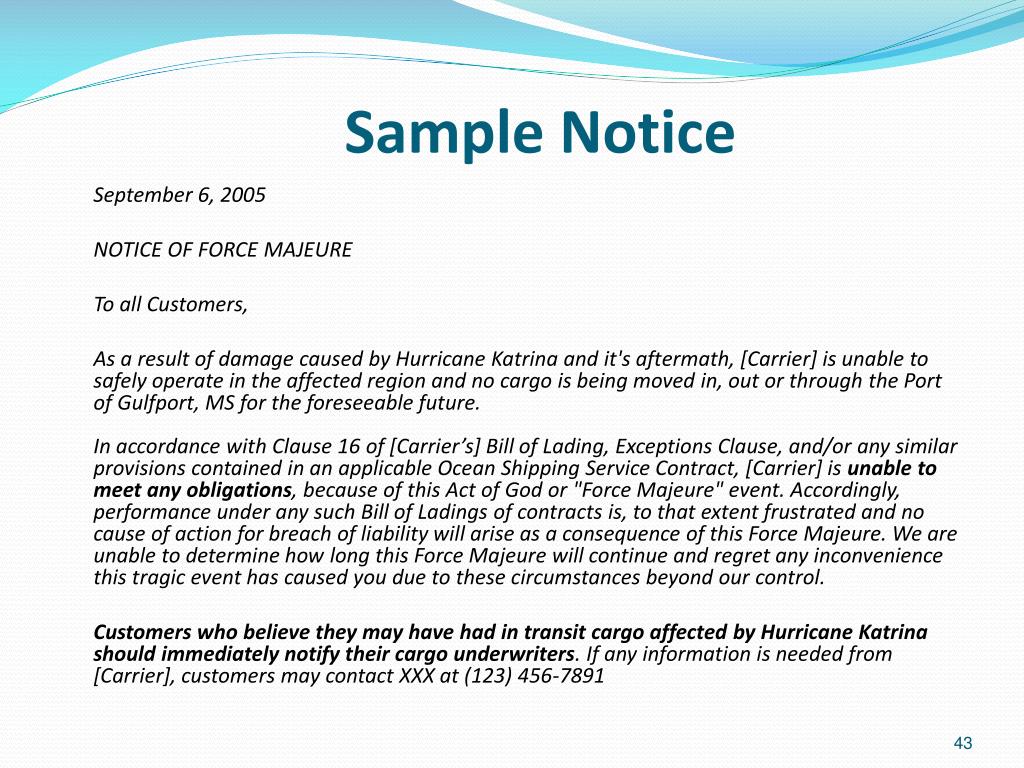
Force Majeure. Neither party shall be liable for any failure or delay in performance under this Agreement to the extent such failure or delay is caused by events beyond its reasonable control, including, but not limited to, acts of God, war, riots, civil commotion, fire, flood, earthquake, hurricane, epidemic, pandemic, explosion, strike, lockout, labor dispute, governmental regulation, order, or decree, failure of public utilities or common carriers, or any other cause beyond the reasonable control of such party (each, a “Force Majeure Event”).
The affected party shall give prompt written notice to the other party of the occurrence of a Force Majeure Event and shall use commercially reasonable efforts to mitigate the effects of the Force Majeure Event and resume performance as soon as reasonably practicable. The suspension of performance due to a Force Majeure Event shall be of no greater scope and of no longer duration than is reasonably required by the Force Majeure Event. If a Force Majeure Event prevents a party from performing its obligations for a continuous period of [Number] days, the other party may terminate this Agreement upon written notice.
Explanation of the Sample Clause Components
- General Excusation of Performance: This opening sentence establishes the core principle: a party is excused from liability for failure or delay in performance if caused by events beyond their reasonable control. The phrase “to the extent” is important. It clarifies that only the portion of performance impacted by the force majeure event is excused. If only a portion of the obligations are affected, the party is still expected to perform the remaining obligations.
- Definition of Force Majeure Events: This section provides a non-exhaustive list of events considered to be force majeure events. The list in the sample includes common examples:
- Acts of God: This generally refers to natural disasters like earthquakes, floods, hurricanes, and extreme weather events.
- War, Riots, Civil Commotion: These encompass acts of violence and unrest that disrupt normal business operations.
- Fire, Flood, Earthquake, Hurricane, Epidemic, Pandemic, Explosion: These are more specific catastrophic events. The inclusion of “epidemic” and “pandemic” has become increasingly common and important in the wake of recent global events.
- Strike, Lockout, Labor Dispute: These relate to disruptions caused by labor issues.
- Governmental Regulation, Order, or Decree: This covers situations where government actions (laws, regulations, court orders) prevent performance.
- Failure of Public Utilities or Common Carriers: This addresses disruptions in essential services like electricity, water, transportation, or communication networks.
- “Or any other cause beyond the reasonable control of such party”: This “catch-all” phrase is crucial. It ensures that unforeseen events not specifically listed are also covered, provided they meet the criteria of being beyond the party’s reasonable control. However, courts often interpret this clause narrowly, requiring that the unlisted event be of a similar nature to the listed events (a concept known as *ejusdem generis*). Therefore, specificity in the list of force majeure events is generally preferred.
The phrase “beyond its reasonable control” is also key. It means the event was not caused by the party’s negligence or willful misconduct, and that the party could not have reasonably prevented or mitigated the event.
- Notice Requirement: The affected party is required to provide “prompt written notice” to the other party upon the occurrence of a force majeure event. This allows the other party to understand the situation and potentially make alternative arrangements. The term “prompt” is somewhat ambiguous and could be subject to interpretation. Specifying a timeframe (e.g., “within five business days”) can add clarity.
- Mitigation Obligation: The clause requires the affected party to use “commercially reasonable efforts” to mitigate the effects of the force majeure event and resume performance as soon as reasonably practicable. This underscores the principle that the party cannot simply cease performance and claim force majeure without actively trying to overcome the obstacle. “Commercially reasonable efforts” is a standard that balances the cost and feasibility of mitigation efforts. It does not require heroic or financially ruinous measures.
- Scope and Duration of Suspension: This sentence clarifies that the suspension of performance is limited to the extent and duration reasonably necessitated by the force majeure event. The party must resume full performance as soon as the event no longer prevents it.
- Termination Right: This section provides a mechanism for the other party to terminate the agreement if the force majeure event continues for an extended period. The sample clause uses “[Number] days” as a placeholder. This timeframe should be carefully considered based on the nature of the contract and the parties’ expectations. A longer duration might be appropriate for long-term contracts, while a shorter duration might be preferable for time-sensitive agreements. This provision provides a way out of the contract if the force majeure event makes continued performance unlikely or impractical.
Important Considerations When Drafting a Force Majeure Clause
- Specificity: While a catch-all provision is useful, try to be as specific as possible when listing potential force majeure events, considering the particular risks associated with the contract and the industry.
- Foreseeability: An event that was reasonably foreseeable at the time of contracting may not be considered a force majeure event.
- Causation: There must be a direct causal link between the force majeure event and the party’s inability to perform.
- Allocation of Risk: Carefully consider which party should bear the risk of specific events. For example, one party might agree to bear the risk of certain government regulations.
- Alternative Performance: Consider whether alternative methods of performance are possible. If so, the clause should address whether the party is obligated to pursue those alternatives.
- Insurance: The clause may address whether the parties are required to maintain insurance coverage for certain force majeure events.
- Jurisdiction: Laws governing force majeure clauses can vary significantly from jurisdiction to jurisdiction. Therefore, it’s crucial to consider the governing law of the contract when drafting the clause.
A well-drafted force majeure clause provides clarity and predictability in the event of unforeseen circumstances, protecting both parties from potentially catastrophic losses. Consulting with legal counsel is highly recommended to ensure that the clause is tailored to the specific needs of the contract and complies with applicable law.
 1080×1480 force majeure template clause contracts legal paige from thelegalpaige.com
  1000×1080 force majeure clause included contracts vector image from www.vectorstock.com
  2872×1532 force majeure clauses praktio from praktio.com
  816×1056 force majeure clause sample frustration contracts force from ashikinajmy26.blogspot.com
  500×645 force majeure clause sample force majeure definition from gobukbldjh.blogspot.com
  744×418 force majeure clause sample icc force majeure hardship clauses from yourremarkablepictures.blogspot.com
  850×1203 force majeure clause sample covid outbreak constitute from theshotgunpictures.blogspot.com
  640×640 force majeure sample clauses clause force sample from www.pinterest.com
  1080×1080 force majeure clause template business interruption clause template from www.etsy.com
  2560×1097 force majeure clause contract epgd business law from www.epgdlaw.com
  936×1214 force majeure clause commercial contracts legal forms from www.uslegalforms.com
  850×1203 force majeure clause template from template.mapadapalavra.ba.gov.br
  1024×768 force majeure clause rent abatement guide full from yswkegejfm.blogspot.com
  1149×942 force majeure definition examples market business news from marketbusinessnews.com
  1024×1024 force majeure clause impact contract black white journal from bnwjournal.com
  940×675 force majeure clauses light covid cwmpk from cwmpk.com
  4106×2740 force majeure contract lawdepotcom from www.lawdepot.com
  638×479 frustration contracts force majeure clauses from www.slideshare.net
  1602×1002 examples force majeure clauses contracts afterpattern from afterpattern.com
  474×237 put force majeure clause contract from www.stpetelawgroup.com
  1653×1168 force majeure pic jeff mccann real estate land consulting from jeffmccann.net
  640×480 unpack contract whats force majeure clause from www.dtnpf.com
  770×1024 fillable force majeure sample clauses sampleslaw insider from www.pdffiller.com
  770×1024 force majeure sample clauses sampleslaw insider template from www.pdffiller.com
  1254×836 coronavirus covid qualify force majeure from www.pagepate.com