
Website Design Agreement Sample
Here’s an HTML outline detailing the key elements to include in a website design agreement sample. This covers the scope of work, timelines, payment terms, intellectual property, and other crucial considerations.
Website Design Agreement
This Website Design Agreement (the “Agreement”) is made and entered into as of [DATE] by and between [CLIENT NAME], residing at [CLIENT ADDRESS] (“Client”), and [DESIGNER/AGENCY NAME], residing at [DESIGNER/AGENCY ADDRESS] (“Designer”).
1. Scope of Work
This section meticulously outlines the services the Designer will provide. Clarity here minimizes future disputes.
- Project Overview: A brief summary of the project, e.g., “Design and development of a responsive website for Client’s [INDUSTRY] business.”
- Specific Deliverables:
- Number of pages to be designed.
- Specific functionality (e.g., contact form, e-commerce integration, blog).
- Content Management System (CMS) to be used (e.g., WordPress, Drupal, custom CMS).
- Mobile responsiveness requirements.
- Search Engine Optimization (SEO) basics (e.g., keyword research, meta-tag optimization). Specify the extent of SEO work; often, a separate SEO agreement is needed for comprehensive services.
- Image sourcing and licensing (specify who is responsible for providing images and ensuring proper licensing).
- Hosting requirements (specify who is responsible for hosting and domain registration).
- Third-party integrations (e.g., social media feeds, payment gateways).
- Accessibility standards compliance (e.g., WCAG).
- Services Not Included: Explicitly list services *not* included to avoid misunderstandings. Examples:
- Content writing (unless explicitly stated).
- Logo design (unless part of the overall package).
- Extensive SEO work beyond basic optimization.
- Ongoing website maintenance after launch (this is often a separate agreement).
2. Project Timeline
This section establishes a clear timeline for project completion. Include key milestones and deadlines.
- Start Date: [DATE]
- Milestones:
- Initial Design Concepts Presented: [DATE]
- Design Revisions Completed: [DATE]
- Development Phase Begins: [DATE]
- Content Population Completed: [DATE] (This often depends on the client providing content on time.)
- Testing and Quality Assurance: [DATE]
- Website Launch: [DATE]
- Delays: A clause addressing potential delays, including:
- How delays caused by the Client (e.g., late content delivery, delayed feedback) will affect the timeline and potentially incur additional charges.
- Force Majeure: A clause addressing unforeseen circumstances beyond either party’s control (e.g., natural disasters, government regulations).
3. Payment Terms
Clearly define the payment schedule and methods.
- Total Project Cost: $[AMOUNT]
- Payment Schedule:
- Initial Deposit: $[AMOUNT] due upon signing this Agreement.
- Second Payment: $[AMOUNT] due upon approval of design concepts.
- Third Payment: $[AMOUNT] due upon completion of the development phase.
- Final Payment: $[AMOUNT] due upon website launch and Client acceptance.
- Payment Methods: Specify accepted payment methods (e.g., check, credit card, bank transfer, PayPal).
- Late Payment Fees: Outline any penalties for late payments (e.g., a percentage-based late fee).
- Expenses: Address reimbursement for any pre-approved expenses incurred by the Designer (e.g., stock photo purchases, software licenses).
4. Intellectual Property
This is a crucial section defining ownership of the website design and code.
- Ownership of Design:
- Option 1 (Designer Retains Ownership): The Designer retains ownership of the design and grants the Client a license to use it on their website. Specify the terms of the license (e.g., exclusive/non-exclusive, territorial restrictions).
- Option 2 (Client Acquires Ownership): Upon full payment, all rights, title, and interest in the website design are transferred to the Client.
- Ownership of Code: Similar to design ownership, specify whether the Client or Designer owns the code. Open-source licenses should be clearly identified.
- Client Content: Client retains ownership of all content provided to the Designer.
- Designer’s Portfolio: Grant the Designer permission to showcase the completed website in their portfolio (unless the Client requests confidentiality).
5. Revisions and Changes
Outline the process for requesting and implementing revisions.
- Number of Revision Rounds: Specify the number of free revision rounds included in the initial price (e.g., two rounds of revisions on the initial design concepts).
- Scope of Revisions: Define what constitutes a “revision” and what would be considered a new feature request subject to additional charges.
- Change Order Process: Establish a process for handling change requests that fall outside the original scope of work, including a description of how the changes will be documented, priced, and approved.
6. Termination
Define the conditions under which either party can terminate the Agreement.
- Termination by Client: Specify any penalties for terminating the Agreement before completion (e.g., forfeiture of deposit, payment for work completed to date).
- Termination by Designer: Specify conditions under which the Designer can terminate the Agreement (e.g., Client breach of contract, failure to provide necessary information).
- Consequences of Termination: Outline the obligations of each party upon termination, including the return of materials and payment for services rendered.
7. Warranties and Disclaimers
Define the warranties provided by the Designer and any disclaimers of liability.
- Warranty: A limited warranty that the website will function as described for a specified period (e.g., 30 days) after launch.
- Disclaimer: A disclaimer of liability for issues arising from third-party software, hosting providers, or changes made to the website by the Client after launch.
8. Confidentiality
Protect sensitive information shared during the project.
- A clause stating that both parties agree to keep confidential any proprietary or sensitive information disclosed by the other party during the course of the project.
9. Governing Law
Specify the jurisdiction whose laws will govern the Agreement.
- This Agreement shall be governed by and construed in accordance with the laws of [STATE/JURISDICTION].
10. Entire Agreement
This clause states that the written agreement represents the complete and final agreement of the parties.
- This Agreement constitutes the entire agreement between the parties with respect to the subject matter hereof and supersedes all prior or contemporaneous communications and proposals, whether oral or written.
11. Signatures
Space for both parties to sign and date the Agreement.
_________________________
[CLIENT NAME]
Date: [DATE]
_________________________
[DESIGNER/AGENCY NAME]
Date: [DATE]
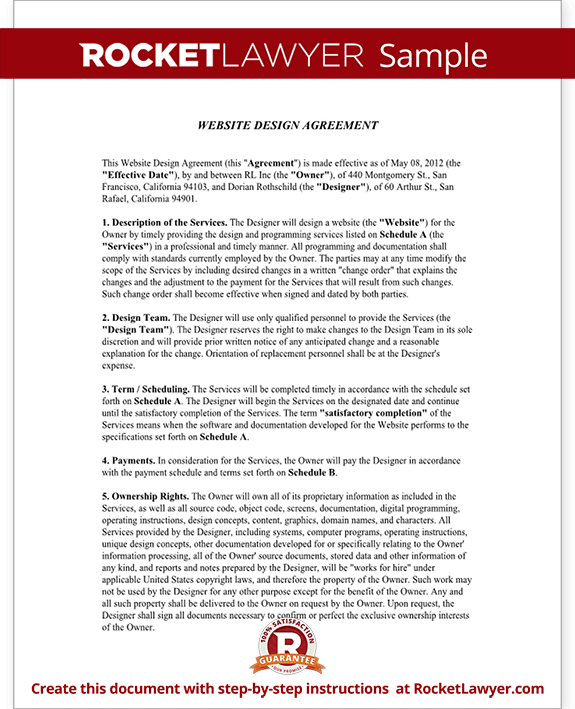 575×709 web design contract template website design agreement sample from rocketlawyer.com
  834×1080 simple website contract template from signaturely.com
  600×730 sample website development agreement templates ms word from www.sampletemplates.com
  768×994 sample website development agreement from www.slideshare.net
768×994 sample website development agreement from www.slideshare.net  728×942 web design contract agreement printable documents from londonmedarb.com
  728×942 website design agreement template from www.slideshare.net
  793×1122 website design agreement templates allbusinesstemplatescom from www.allbusinesstemplates.com