
Indemnity Clause Template In Contracts
Indemnity Clause Template: Protecting Your Interests in Contracts
An indemnity clause, also known as a hold harmless clause, is a crucial provision in many contracts. It essentially shifts potential risk and liability from one party to another. Understanding indemnity clauses and having a solid template can be vital for protecting your business from unexpected financial burdens.
What is an Indemnity Clause?
At its core, an indemnity clause is a contractual promise by one party (the indemnitor) to protect another party (the indemnitee) against specific losses, damages, liabilities, or expenses. This protection typically arises from a third-party claim or lawsuit. Think of it as an agreement to “stand in the shoes” of the indemnitee and cover their losses in certain defined circumstances.
Indemnity clauses are not a “get out of jail free” card. Their scope is typically limited to specifically described risks and losses. They’re designed to allocate responsibility fairly, based on the nature of the relationship and the potential for specific harm.
Why Use an Indemnity Clause?
Indemnity clauses are used to:
- Allocate Risk: Clearly define which party bears the financial burden for specific risks associated with the contract.
- Protect Against Lawsuits: Shield a party from the cost of defending against and settling third-party claims.
- Encourage Cooperation: Promote efficient collaboration by assigning responsibility for potential errors or omissions.
- Manage Insurance Coverage: Work in conjunction with insurance policies to provide comprehensive risk management.
- Provide Certainty: Establish clear financial consequences for specific events, reducing potential disputes.
Key Elements of an Indemnity Clause Template
A well-drafted indemnity clause template should include the following essential elements:
- Identification of Parties: Clearly identify both the indemnitor (the party providing the indemnity) and the indemnitee (the party receiving the indemnity).
- Scope of Indemnity: Precisely define the types of losses, damages, liabilities, costs, and expenses covered by the indemnity. This might include attorney’s fees, court costs, settlements, judgments, and other related expenses. Be specific and avoid overly broad or vague language.
- Triggering Events: Specify the events or circumstances that trigger the indemnity obligation. These might include breach of contract, negligence, willful misconduct, violation of laws, or product defects. The triggering events must be clearly and unambiguously defined.
- Limitations on Indemnity: Outline any limitations on the indemnity obligation. This might include monetary caps, exclusions for certain types of losses (e.g., consequential damages), or time limits for making claims.
- Notice Requirements: Establish a clear procedure for the indemnitee to provide notice of a claim to the indemnitor. This should include a reasonable timeframe for providing notice and the required method of delivery (e.g., certified mail).
- Duty to Defend: Specify whether the indemnitor has a duty to defend the indemnitee against any third-party claims. This means the indemnitor is responsible for hiring and paying for legal counsel to defend the indemnitee.
- Right to Settle: Define the rights of both parties regarding settlement of claims. Typically, the indemnitor will have the right to control the defense and settlement of claims, but the indemnitee may retain the right to approve any settlement that could adversely affect their reputation or business interests.
- Choice of Law: Specify the governing law that will be used to interpret and enforce the indemnity clause.
- Exclusions: Clearly state what is not covered by the indemnity. Common exclusions include gross negligence or willful misconduct of the indemnitee, pre-existing conditions, or losses arising from events outside the control of the indemnitor.
Example Indemnity Clause Template
Indemnification. [Indemnitor Name] agrees to indemnify, defend, and hold harmless [Indemnitee Name], its officers, directors, employees, and agents (collectively, the “Indemnitee”) from and against any and all claims, losses, damages, liabilities, costs, and expenses (including reasonable attorneys’ fees) arising out of or relating to (a) any breach of this Agreement by [Indemnitor Name], (b) any negligent act or omission or willful misconduct of [Indemnitor Name] in connection with the performance of its obligations under this Agreement, (c) any violation of any applicable law, rule, or regulation by [Indemnitor Name], or (d) any product liability claim arising from the products or services provided by [Indemnitor Name] under this Agreement.
Notice. Indemnitee shall promptly notify [Indemnitor Name] in writing of any claim for which Indemnitee intends to seek indemnification under this Agreement. [Indemnitor Name] shall have the right to control the defense and settlement of any such claim, provided that [Indemnitor Name] shall not settle any claim without the prior written consent of Indemnitee if such settlement would require Indemnitee to admit fault or incur any non-monetary obligation.
Limitations. [Indemnitor Name]’s obligation to indemnify Indemnitee under this Agreement shall be limited to the amount of insurance coverage maintained by [Indemnitor Name]. In no event shall [Indemnitor Name] be liable for any consequential, incidental, or punitive damages.
Exclusions. The indemnification obligations under this Agreement shall not apply to the extent that any claim, loss, damage, liability, cost, or expense is caused by the gross negligence or willful misconduct of Indemnitee.
Important Considerations
- Negotiation: Indemnity clauses are often heavily negotiated. Be prepared to discuss and potentially compromise on the scope of the indemnity, the triggering events, and any limitations or exclusions.
- Insurance Coverage: Review your insurance policies to ensure that you have adequate coverage for the risks associated with the indemnity clause. You may need to obtain additional insurance or endorsements to cover your indemnity obligations.
- State Laws: Indemnity laws vary from state to state. Consult with an attorney to ensure that your indemnity clause is enforceable in the relevant jurisdiction. Some states have specific statutes that restrict or prohibit certain types of indemnity agreements.
- Clarity and Specificity: Ambiguous or overly broad indemnity clauses can be difficult to enforce. Strive for clarity and specificity in defining the scope of the indemnity, the triggering events, and any limitations or exclusions.
- “Duty to Defend”: Carefully consider whether to include a duty to defend. This can significantly increase the indemnitor’s costs, but it can also provide greater protection for the indemnitee.
When to Seek Legal Advice
Indemnity clauses can be complex and have significant legal and financial implications. It’s always best to consult with an experienced attorney when drafting or negotiating an indemnity clause, especially in the following situations:
- The contract involves significant financial risk.
- The contract involves complex or novel legal issues.
- You are unsure about the scope of your potential liability.
- You are being asked to provide an indemnity that seems overly broad or unfair.
By understanding the key elements of an indemnity clause template and carefully considering the specific circumstances of your contract, you can protect your business from unexpected financial burdens and ensure that risks are allocated fairly.
 600×730 indemnity agreements sample format from www.template.net
  834×1080 indemnification agreement sample from signaturely.com
  585×600 sample indemnity agreement templates ms word from www.sampletemplates.com
  816×1056 indemnity agreement templates allbusinesstemplatescom from www.allbusinesstemplates.com
  532×551 indemnity agreement template word from www.wonder.legal
  696×900 indemnity agreement word formats from www.dexform.com
  696×900 indemnity agreement documents word excel from www.dexform.com
  575×709 indemnity agreement template form sample from www.rocketlawyer.com
 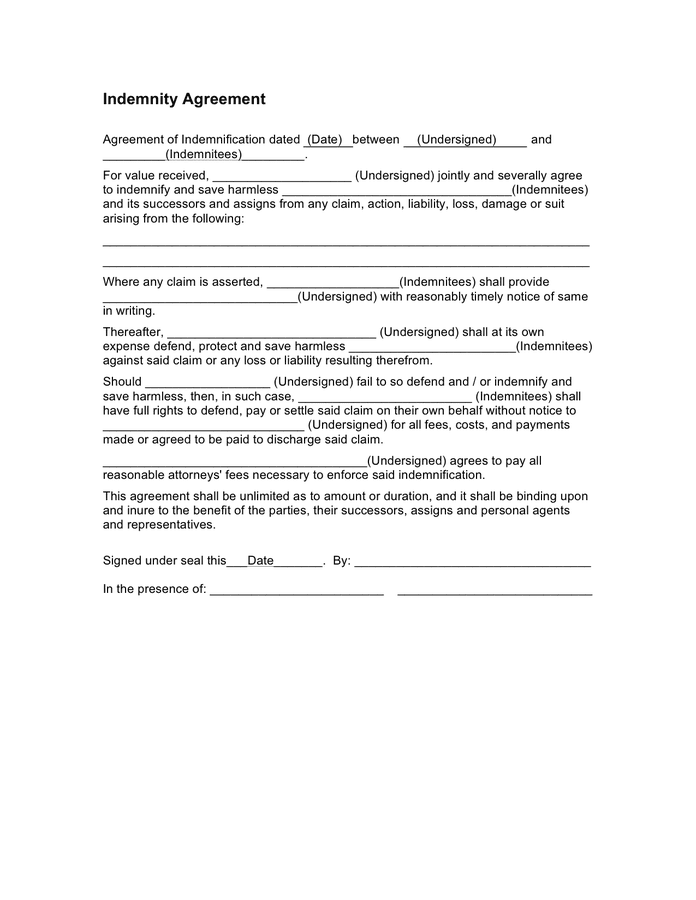 696×900 indemnity agreement template word formats from www.dexform.com
  489×614 hold harmless indemnity agreement sample approvemecom from www.approveme.com