
Public Relations Memo Template
Here’s an HTML formatted piece about public relations memo templates, aiming for around 900 words: Public Relations Memo Template
A public relations (PR) memo is a vital internal communication tool used to disseminate information, provide updates, propose strategies, and request approvals within a PR team or to stakeholders. A well-crafted PR memo ensures clarity, consistency, and alignment on PR efforts. Using a template can streamline the process and ensure all essential elements are included.
Why Use a PR Memo Template?
- Efficiency: Templates save time by providing a pre-formatted structure, eliminating the need to start from scratch each time.
- Consistency: They ensure that all PR memos adhere to a uniform style and format, enhancing professionalism and readability.
- Clarity: Templates guide the writer to include all necessary information, reducing ambiguity and miscommunication.
- Compliance: They help ensure that all memos comply with company standards and legal requirements.
- Organization: Templates promote logical organization of information, making it easier for recipients to understand and act upon the content.
Key Components of a PR Memo Template
A typical PR memo template includes the following elements:
- Header:
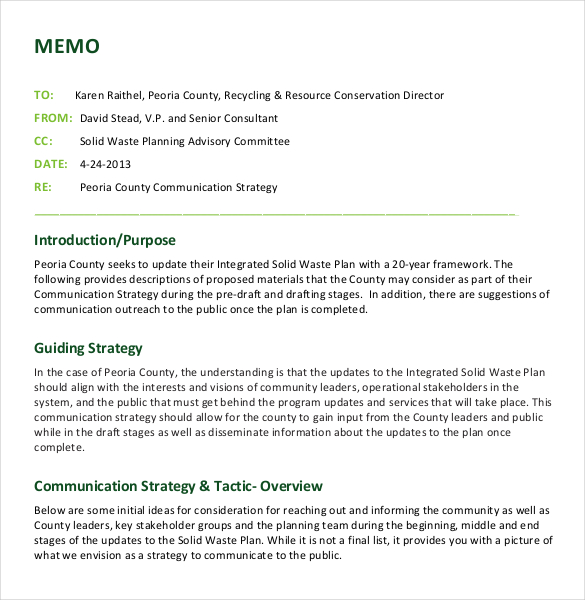
- To: Name(s) and title(s) of the recipient(s). Be specific. “PR Team” is less helpful than “Jane Doe, Senior PR Manager; John Smith, PR Specialist.”
- From: Your name and title.
- Date: The date the memo is being sent.
- Subject: A concise and informative subject line that clearly indicates the memo’s purpose. Examples: “Proposed Media Outreach Strategy for Q3 Launch,” “Update on Crisis Communication Plan,” “Request for Approval: Sponsorship of Local Charity Event.”
- Introduction (Executive Summary):
- A brief overview of the memo’s purpose and key points. This section should immediately capture the reader’s attention and provide context. Keep it concise – typically no more than 2-3 sentences. Imagine the reader only has 30 seconds.
- State the objective clearly. What are you trying to achieve with this memo? Are you informing, persuading, requesting, or updating?
- Background/Context:
- Provide relevant background information or context that is necessary for understanding the memo’s content.
- This may include details about a project, campaign, issue, or event.
- Include any relevant data, research findings, or past performance metrics. This provides a foundation for your recommendations or updates.
- Main Body (Details and Analysis):
- This section contains the core information of the memo, broken down into logical paragraphs or sections.
- Present information clearly, concisely, and objectively.
- Use bullet points, numbered lists, or headings to improve readability and organization.
- Provide evidence to support your statements, such as data, examples, or testimonials.
- If the memo proposes a strategy or plan, outline the specific tactics, timelines, and resources required.
- If the memo is an update, provide detailed information about progress, challenges, and next steps.
- Recommendations (if applicable):
- If the memo aims to influence a decision or action, clearly state your recommendations.
- Explain the rationale behind your recommendations and the potential benefits of implementing them.
- Provide alternative options, if appropriate, and explain why you are recommending a particular course of action.
- Be specific and actionable. Don’t just say “Improve media relations.” Say “Implement a targeted outreach program to key journalists in the technology sector, focusing on publications such as Wired, TechCrunch, and The Verge.”
- Call to Action/Next Steps:
- Clearly state the desired action from the recipient(s).
- This could include approving a proposal, providing feedback, attending a meeting, or delegating tasks.
- Provide a clear deadline for the action.
- Make it easy for the reader to respond or take the necessary steps.
- Conclusion:
- Summarize the key points of the memo and reiterate the desired outcome.
- Express gratitude for the recipient’s time and consideration.
- Offer to answer any questions or provide further information.
- Attachments (if applicable):
- List any documents or files that are attached to the memo, such as press releases, reports, presentations, or research data.
- Ensure that attachments are clearly labeled and easily accessible.
- Contact Information:
- Reiterate your contact information (phone number, email address) to facilitate follow-up communication.
Example Scenarios and Template Adaptations
The specific content and format of a PR memo template may vary depending on the purpose and audience. Here are some examples:
- Crisis Communication Memo: This template would focus on outlining the crisis situation, potential impact, communication strategy, key messages, and roles and responsibilities. It would emphasize speed and accuracy.
- Media Relations Strategy Memo: This template would detail the target audience, media outlets, key messages, outreach tactics, and measurement metrics. It would include a timeline and budget.
- Event Planning Memo: This template would cover the event objectives, target audience, logistics, budget, promotion strategy, and post-event evaluation plan.
- Internal Communication Memo: This template would focus on providing updates to employees, announcing new initiatives, or addressing internal issues. Tone and clarity are especially important.
Tips for Writing Effective PR Memos
- Know your audience: Tailor your language and tone to the recipient(s).
- Be clear and concise: Avoid jargon and unnecessary details.
- Be objective and factual: Support your statements with evidence.
- Proofread carefully: Ensure that the memo is free of errors in grammar and spelling.
- Use a professional tone: Maintain a respectful and courteous demeanor.
- Format for readability: Use headings, bullet points, and white space to make the memo easy to read.
- Consider visual aids: Charts, graphs, or images can enhance understanding.
- Prioritize information: Place the most important information at the beginning of the memo.
- Obtain feedback: Ask a colleague to review the memo before sending it.
- Follow up: Ensure that the recipient(s) have received the memo and understand its contents.
By utilizing a well-designed PR memo template and following these best practices, PR professionals can communicate effectively, streamline their workflow, and achieve their desired outcomes.
 2424×3140 policy memo template from www.formsbirds.com
  585×600 memo templates printable word excel from www.wordpdftemplates.com
  696×900 professional memo template documents word from www.dexform.com
  583×427 memo public relations communications from prinz.org.nz
  768×1024 memo template templates word excel from www.formsbirds.com
  791×1024 memo template from studylib.net