
Holiday Announcement Memo Sample
“`html
Holiday Announcement Memo Sample
Announcing holidays is a crucial part of internal communication within any organization. A well-crafted holiday announcement memo ensures that all employees are informed about upcoming holidays, company closures, and any related procedures. This not only helps in planning their personal schedules but also allows departments to prepare for the operational adjustments needed during those periods. This document outlines the essential elements of a holiday announcement memo, provides a sample template, and offers best practices for ensuring clear and effective communication.
Key Components of a Holiday Announcement Memo
- Subject Line: A clear and concise subject line is paramount. It should immediately inform the reader of the memo’s purpose. Examples include: “Holiday Announcement: [Holiday Name]”, “Company Closure: [Holiday Name]”, or “Important: Upcoming Holiday Closure.”
- Date: Include the date the memo is issued. This provides a reference point and helps employees track the information.
- Recipient(s): Specify the intended audience. This could be “All Employees,” “Department [Department Name],” or specific individuals.
- Opening Salutation: Use a professional and respectful greeting, such as “Dear Employees,” or “To All Staff Members.”
- Holiday Announcement: Clearly state the holiday being announced and the specific date(s) of observance. Avoid ambiguity. For example: “This memo is to inform you that [Company Name] will be closed on [Date] in observance of [Holiday Name].”
- Closure Details: Provide precise details regarding the office closure. This includes the start and end dates of the closure, the date when normal operations will resume, and any exceptions to the closure. For instance: “The office will be closed from [Start Date] to [End Date], reopening on [Date]. Regular business hours will resume on [Date].”
- Payroll and Time-Off Information: Clearly communicate information about how employees will be paid for the holiday and the process for requesting time off surrounding the holiday. This section should clarify whether the holiday is a paid holiday and if any specific conditions apply (e.g., eligibility requirements). Additionally, explain the company’s policy on using vacation time or other forms of leave during the holiday period. Include instructions or links to relevant HR policies or online systems for requesting time off.
- Deadline for Time-Off Requests (If Applicable): If there’s a deadline for requesting vacation time around the holiday, prominently state it. This helps ensure sufficient staffing and operational planning. Example: “The deadline for submitting time-off requests for the [Holiday Name] period is [Date].”
- Departmental Considerations: Address any department-specific instructions or requirements. For example, if certain departments need to maintain limited operations during the closure, specify those departments and provide clear instructions on staffing and responsibilities. Similarly, if there are critical tasks that need to be completed before the closure, outline those tasks and assign responsibility.
- Emergency Contact Information: Provide contact information for essential personnel who can be reached in case of emergencies during the closure. This is crucial for addressing unforeseen circumstances and ensuring business continuity. Clearly state the circumstances under which these contacts should be used.
- Acknowledgement of Receipt (Optional): For important announcements, consider requesting employees to acknowledge receipt of the memo. This can be done through a reply email or a designated online system. This ensures that employees have received and understood the information.
- Closing Salutation: End with a professional closing, such as “Sincerely,” “Best Regards,” or “Thank you.”
- Signature: Include the name and title of the person issuing the memo. This adds credibility and accountability.
Sample Holiday Announcement Memo
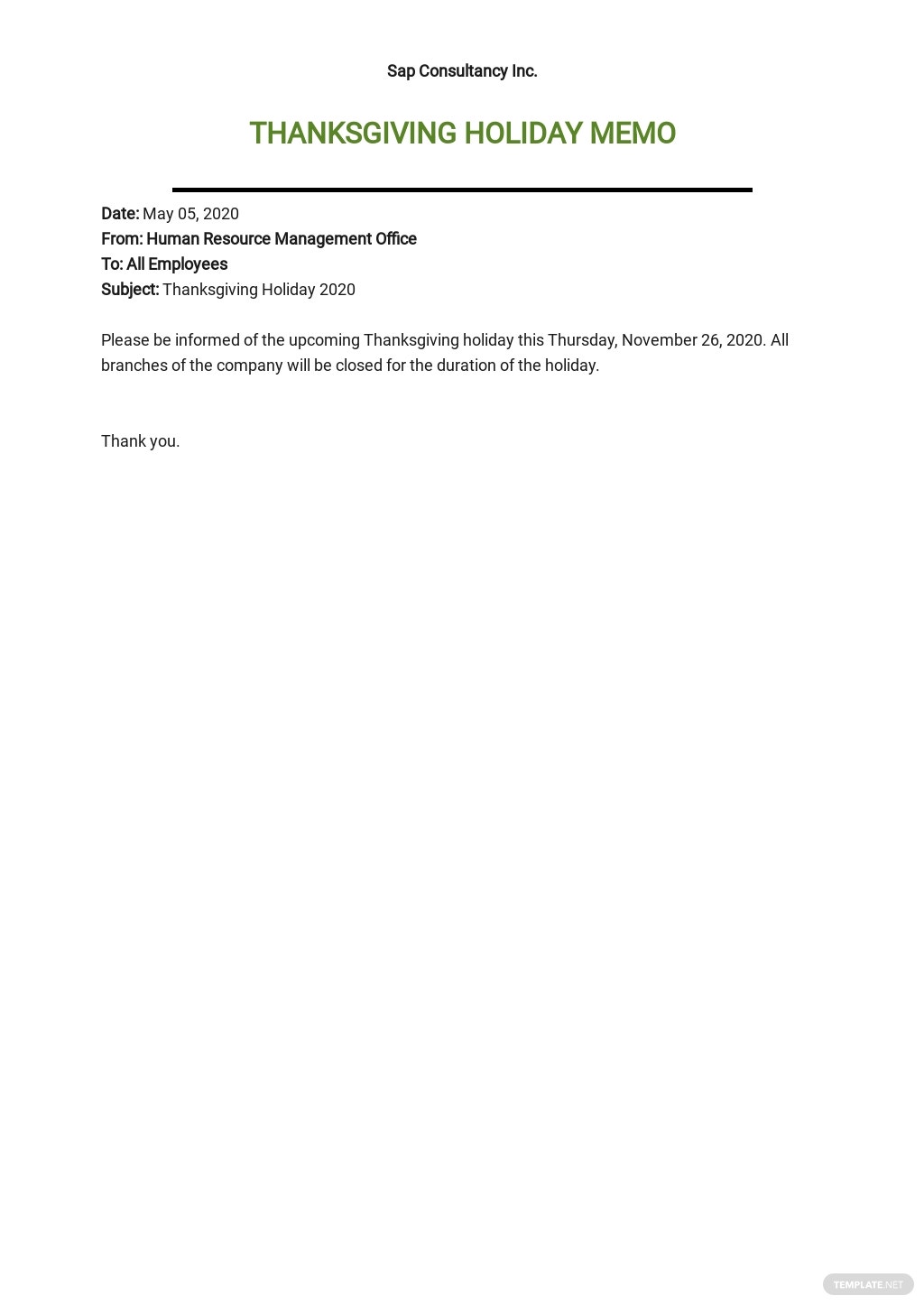
Subject: Holiday Announcement: Thanksgiving Day Closure
Date: October 26, 2023
To: All Employees
Dear Employees,
This memo is to inform you that [Company Name] will be closed on Thursday, November 23, 2023, in observance of Thanksgiving Day.
The office will be closed from Thursday, November 23, 2023, to Friday, November 24, 2023, reopening on Monday, November 27, 2023. Regular business hours will resume on Monday, November 27, 2023.
Thanksgiving Day is a paid holiday for all eligible employees. Please refer to the company’s holiday policy on the intranet for eligibility requirements and details regarding holiday pay.
If you wish to take additional time off around the Thanksgiving holiday, please submit your vacation requests through the HR portal by November 10, 2023. This will allow us to ensure adequate staffing levels and minimize disruption to our operations.
For the Customer Support Department: A skeleton crew will be required to provide essential support on Friday, November 24, 2023. Your supervisor will contact you to schedule coverage. Employees working on November 24th will receive holiday pay plus time and a half.
In the event of a critical emergency during the closure, please contact [Name] at [Phone Number] or [Email Address].
Thank you for your hard work and dedication. We wish you a happy and safe Thanksgiving!
Sincerely,
[Your Name]
[Your Title]
Best Practices for Effective Holiday Announcements
- Timeliness: Issue the announcement well in advance of the holiday to give employees ample time to plan.
- Clarity: Use clear and concise language, avoiding jargon or ambiguous terms.
- Accessibility: Distribute the memo through multiple channels, such as email, company intranet, and physical bulletin boards, to ensure all employees receive the information.
- Consistency: Maintain a consistent format and style for all holiday announcements to avoid confusion.
- Review and Proofread: Carefully review and proofread the memo for errors in grammar, spelling, and dates before distribution.
- Address Employee Questions: Be prepared to answer employee questions regarding the holiday announcement. Provide a designated point of contact for inquiries.
- Consider a Holiday Calendar: Maintain a company holiday calendar readily available to employees throughout the year. This proactive approach minimizes confusion and aids in long-term planning.
- Cultural Sensitivity: Be mindful of diverse cultural and religious holidays. Consider offering floating holidays to accommodate individual preferences.
By following these guidelines, organizations can ensure that holiday announcements are clear, effective, and contribute to a positive and well-informed work environment.
“`
 585×685 holiday memo template documents sample templates from www.sampletemplates.com
  585×594 holiday memo samples sample templates from www.sampletemplates.com
  440×570 sample holiday memo templates ms word google docs from www.sampletemplates.com
  600×730 holiday memo examples from www.examples.com
  585×480 holiday memo templates word google docs documents from www.template.net
  1000×1000 announcement public holiday from www.grad.au.edu
  600×590 holiday memo templates sample formats from www.creativetemplate.net
  429×554 announcement sample holiday master template document from belogimannabila.blogspot.com
  600×730 notice memos from www.sampletemplates.com
  432×552 memorial day holiday announcement letters document hub from www.doxhub.org
  580×540 sample casual memo letter templates word from www.sampletemplates.com
  1024×1446 memo samples format examples from www.template.net
  600×730 sample holiday letter templates word from www.sampletemplates.com
  1024×768 announce public holiday letter templates from writolay.com
  564×729 letter written holiday announcements form from www.pinterest.com