
Fitness Trainer Agreement Template
Here’s an HTML formatted outline of a fitness trainer agreement template, targeting around 900 words.
Fitness Trainer Agreement Template: A Comprehensive Guide
A well-structured Fitness Trainer Agreement is crucial for protecting both the trainer and the client. This agreement outlines the scope of services, payment terms, liability waivers, and other essential details, ensuring a clear and professional relationship. This guide will break down the key components of a robust fitness trainer agreement template.
1. Header & Introductory Section: Setting the Stage
The agreement should begin with a clear title, such as “Fitness Training Agreement.” The introductory paragraph should identify the parties involved: the fitness trainer (or the training company) and the client. Include their full legal names and addresses. State the effective date of the agreement – the date when it comes into force. A brief introductory statement summarizing the purpose of the agreement, namely the provision of fitness training services, is also essential. Example:
“This Fitness Training Agreement (the “Agreement”) is made and entered into as of [Date] by and between [Trainer’s Full Name or Company Name], residing at [Trainer’s Address] (“Trainer”) and [Client’s Full Name], residing at [Client’s Address] (“Client”). Trainer agrees to provide fitness training services to Client, and Client agrees to pay Trainer for such services, subject to the terms and conditions set forth herein.”
2. Scope of Services: Defining What’s Included
This section is the heart of the agreement. It clearly defines the services the trainer will provide. Be as specific as possible to avoid misunderstandings. Include details such as:
- Type of Training: Specify the type of fitness training (e.g., one-on-one personal training, group classes, online coaching, specialized training like strength training, cardiovascular training, weight loss programs, etc.).
- Training Schedule: Outline the frequency, duration, and location of the training sessions (e.g., “Three one-hour sessions per week at [Gym Name/Client’s Home] on Mondays, Wednesdays, and Fridays at 6:00 PM”). Include provisions for scheduling changes or cancellations (see section 5).
- Personalized Program Design: State whether the trainer will develop a personalized fitness program based on the client’s individual goals, fitness level, and health history. Describe the process of assessment and program modification.
- Nutritional Guidance: Indicate if nutritional advice or meal planning is included. If so, clarify the extent of the guidance and emphasize that the trainer is not a registered dietitian (unless they are) and cannot provide medical nutrition therapy. A disclaimer is essential here.
- Progress Tracking: Detail how the trainer will monitor the client’s progress (e.g., regular weigh-ins, body composition analysis, fitness assessments, progress photos).
- Communication: Specify the methods of communication (e.g., email, phone, text) and the expected response time.
3. Payment Terms: Clear and Unambiguous
This section is crucial for avoiding payment disputes. Clearly state:
- Fees: Specify the fee structure (e.g., hourly rate, per-session rate, package pricing, monthly subscription). If offering packages, clearly outline the number of sessions included and the validity period.
- Payment Schedule: Define when payments are due (e.g., at the beginning of each session, weekly, monthly).
- Payment Methods: List the accepted payment methods (e.g., cash, check, credit card, electronic funds transfer).
- Late Payment Policy: Outline any penalties for late payments (e.g., late fee, suspension of services).
- Refund Policy: Describe the circumstances under which refunds may be granted (e.g., termination of the agreement due to trainer’s fault, client’s medical inability to continue training). Be specific and avoid vague language. Consider whether partial refunds will be offered for unused sessions in a package.
- Price Increases: Include a clause addressing potential price increases, specifying how much notice will be given to the client.
4. Cancellation & Rescheduling Policy: Managing Appointments
A clear cancellation and rescheduling policy is essential for managing your schedule effectively. Address the following:
- Client Cancellation: Specify the amount of notice the client must provide to cancel or reschedule a session without penalty (e.g., “24 hours’ notice is required for cancellations. Cancellations with less than 24 hours’ notice will be charged the full session fee.”).
- Trainer Cancellation: Outline the trainer’s policy for cancellations, including how the client will be notified and how the session will be rescheduled or credited.
- No-Show Policy: Define the consequences of a client failing to attend a scheduled session without notice (e.g., the session will be forfeited and charged).
5. Client Responsibilities: Shared Accountability
This section outlines the client’s responsibilities, ensuring they understand their role in achieving their fitness goals. Include points such as:
- Honest Disclosure: The client’s responsibility to provide accurate and complete information about their health history, medical conditions, and any limitations that may affect their ability to participate in the training program.
- Following Instructions: The client’s obligation to follow the trainer’s instructions and recommendations.
- Informing of Changes: The client’s responsibility to inform the trainer of any changes in their health condition or fitness level.
- Punctuality: The client’s responsibility to arrive on time for scheduled sessions.
6. Liability Waiver & Release: Protecting the Trainer
This is a crucial section for protecting the trainer from liability for injuries sustained during training. The waiver should:
- Acknowledge Risks: Clearly state that physical exercise involves inherent risks of injury, including but not limited to muscle strains, sprains, and more serious injuries.
- Assumption of Risk: The client acknowledges and assumes these risks voluntarily.
- Release of Liability: The client releases the trainer (and the training company, if applicable) from any and all liability for injuries sustained during training, except in cases of gross negligence or willful misconduct on the part of the trainer.
- Medical Clearance: Include a statement recommending that the client consult with a physician before starting any new exercise program.
7. Confidentiality: Protecting Client Information
This section ensures the client’s privacy by stating that the trainer will keep their personal information (including health information) confidential. Include exceptions for legal requirements (e.g., court orders). Specify how long client records will be stored and how they will be disposed of securely.
8. Termination Clause: Ending the Agreement
Outline the conditions under which either party can terminate the agreement. Include provisions for:
- Termination by Client: Specify the notice period required for the client to terminate the agreement (e.g., “Client may terminate this agreement with [Number] days’ written notice.”). Address the refund of any unused sessions in a package.
- Termination by Trainer: Outline the circumstances under which the trainer can terminate the agreement (e.g., client’s failure to pay, client’s disruptive behavior, client’s failure to follow instructions).
- Consequences of Termination: Clarify any financial consequences of termination, such as forfeiture of prepaid fees.
9. Governing Law: Jurisdiction
State the state law that will govern the agreement. This ensures clarity in case of legal disputes.
10. Entire Agreement: Completeness
This clause states that the agreement constitutes the entire agreement between the parties and supersedes any prior agreements or understandings, whether written or oral.
11. Severability: Protecting the Agreement
This clause states that if any provision of the agreement is found to be invalid or unenforceable, the remaining provisions will remain in full force and effect.
12. Signatures & Date: Formalizing the Agreement
The agreement should be signed and dated by both the trainer and the client. Include spaces for printed names and titles (if applicable).
Disclaimer: This is a general template and may not be suitable for all situations. Consult with an attorney to ensure that your fitness trainer agreement is legally sound and meets your specific needs.
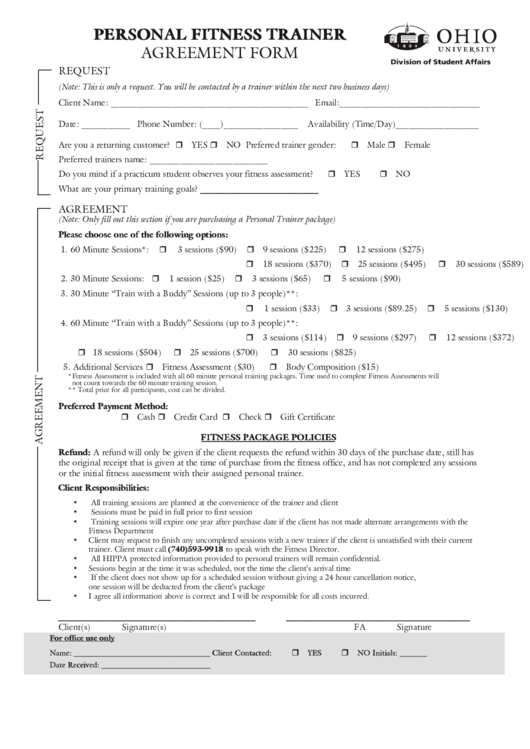 530×749 personal fitness trainer agreement form printable from www.formsbank.com
  1275×1650 personal trainer contract agreement printable documents from londonmedarb.com
  585×660 gym contract templates ms word google docs apple pages from www.template.net
  298×386 printable personal trainer agreement gym forms templates from www.pdffiller.com
  1024×1446 personal trainer independent contractor agreement template from www.template.net
  850×1100 personal training trainer fitness center membership application from www.uslegalforms.com