
Employee Disciplinary Memo Template
Employee Disciplinary Memo Template: A Comprehensive Guide
An employee disciplinary memo serves as a formal record of misconduct or performance issues and the consequences that follow. It’s a crucial tool for employers to address problems, document corrective actions, and ensure fairness and consistency in the workplace. Using a standardized template can streamline the process, maintain legal compliance, and protect your company from potential liabilities.
Why Use a Disciplinary Memo Template?
* **Consistency:** A template ensures that all disciplinary actions are documented in a uniform manner, reducing the risk of bias or inconsistent treatment of employees. * **Clarity:** It provides a structured format for clearly outlining the issue, the expectations, and the consequences, minimizing ambiguity and ensuring the employee understands the situation. * **Legal Protection:** Well-documented disciplinary actions are essential for defending against potential wrongful termination lawsuits or claims of discrimination. * **Efficiency:** A pre-designed template saves time and effort by providing a framework for recording the necessary information. * **Documentation:** It creates a written record of the disciplinary process, which can be used for performance reviews, future disciplinary actions, or legal proceedings.
Essential Elements of a Disciplinary Memo Template
A comprehensive disciplinary memo template should include the following key elements: * **Company Letterhead/Logo:** This establishes the document’s authenticity and official nature. * **Date:** The date the memo is issued is crucial for tracking the disciplinary process. * **Employee Name and Title:** Clearly identify the employee being disciplined. * **Employee ID Number:** Helps in accurate record-keeping, especially in larger organizations. * **Manager/Supervisor Name and Title:** Identifies the person issuing the disciplinary action. * **Subject Line:** A clear and concise subject line, such as “Disciplinary Action Regarding [Specific Issue],” helps the employee understand the memo’s purpose immediately.
Body of the Memo:
* **Opening Statement:** Briefly state the purpose of the memo and the reason for the disciplinary action. For example: “This memo is to inform you of a disciplinary action resulting from [specific incident or behavior].” * **Detailed Description of the Incident/Problem:** Provide a factual, specific, and objective description of the incident or performance issue. Avoid subjective opinions or emotional language. Include dates, times, locations, and any witnesses present. * **Company Policy Violation:** Clearly state which company policy or procedure was violated. Refer to specific sections of the employee handbook or other relevant documents. * **Impact of the Violation:** Explain how the employee’s actions or performance have negatively impacted the company, its customers, or other employees. * **Previous Warnings (If Applicable):** If this is not the first disciplinary action, mention any previous warnings or counseling sessions related to the same or similar issues. Include dates and summaries of those discussions. * **Expected Improvement:** Clearly state the specific changes in behavior or performance that are expected of the employee. Be measurable and provide clear timelines for improvement. For example, “You are expected to [specific action] by [date].” * **Consequences of Failure to Improve:** Outline the potential consequences if the employee fails to meet the expectations outlined in the memo. This could include further disciplinary action, suspension, demotion, or termination. * **Opportunity for Employee Response:** Provide the employee with an opportunity to respond to the allegations or offer their perspective. Include a statement such as, “You are encouraged to provide a written response to this memo within [number] days.” * **Assistance and Support:** If applicable, offer resources or support that the employee can utilize to improve their performance. This could include training, coaching, or counseling. * **Closing Statement:** Reiterate the seriousness of the situation and emphasize the company’s commitment to fair and consistent disciplinary practices.
Signatures and Acknowledgement:
* **Manager/Supervisor Signature:** The manager or supervisor issuing the memo should sign and date it. * **Employee Signature:** The employee should sign the memo to acknowledge receipt. This does not necessarily mean the employee agrees with the contents, but rather that they have received and read the document. * **Witness Signature (Optional):** If a witness was present during the discussion, their signature can provide additional verification. * **Date of Signature:** The date the memo was signed by each party should be recorded.
Tips for Using a Disciplinary Memo Template Effectively
* **Investigate Thoroughly:** Before issuing a disciplinary memo, conduct a thorough investigation to gather all the facts and ensure the allegations are accurate. * **Be Objective and Fair:** Focus on the facts and avoid personal opinions or biases. Treat all employees fairly and consistently. * **Maintain Confidentiality:** Handle disciplinary matters with discretion and respect for the employee’s privacy. * **Document Everything:** Keep detailed records of all disciplinary actions, including the memo, any supporting documentation, and any subsequent conversations with the employee. * **Consult with HR:** Before issuing a disciplinary memo, consult with your HR department to ensure compliance with company policies and legal requirements. * **Deliver the Memo in Person:** If possible, deliver the memo in person during a private meeting with the employee. This allows for a discussion of the issues and an opportunity for the employee to ask questions. * **Listen to the Employee:** Give the employee a chance to respond to the allegations and offer their perspective. * **Follow Up:** Monitor the employee’s progress and provide feedback. If the employee fails to improve, take further disciplinary action as necessary. * **Store Securely:** Keep disciplinary memos in a secure location, separate from the employee’s general personnel file, with access restricted to authorized personnel.
Example Snippets for Different Scenarios
* **Tardiness:** “This memo addresses your consistent tardiness. On [date], [date], and [date], you arrived to work [number] minutes late. This violates company policy [policy number] which states…” * **Insubordination:** “This memo addresses your insubordinate behavior on [date] when you refused to follow a direct order from [manager’s name] to [specific task]. This violates company policy [policy number] regarding respect for supervisors.” * **Poor Performance:** “This memo addresses your performance issues related to [specific task or responsibility]. Your performance has not met the required standards as outlined in your job description. Specifically, [provide examples]…” * **Violation of Safety Procedures:** “This memo addresses your violation of safety procedures on [date] when you [specific action]. This created a potential safety hazard for yourself and others. This violates company policy [policy number] regarding safety regulations.” By using a well-designed disciplinary memo template and following these guidelines, you can effectively address employee performance issues, maintain a fair and consistent workplace, and protect your company from potential legal liabilities. Remember to always consult with your HR department and legal counsel to ensure compliance with all applicable laws and regulations.
 800×418 employee disciplinary memo excel template exceldatapro from exceldatapro.com
  600×730 disciplinary memo templates google docs ms word apple pages from www.sampletemplates.com
  600×730 employee memo examples from www.examples.com
 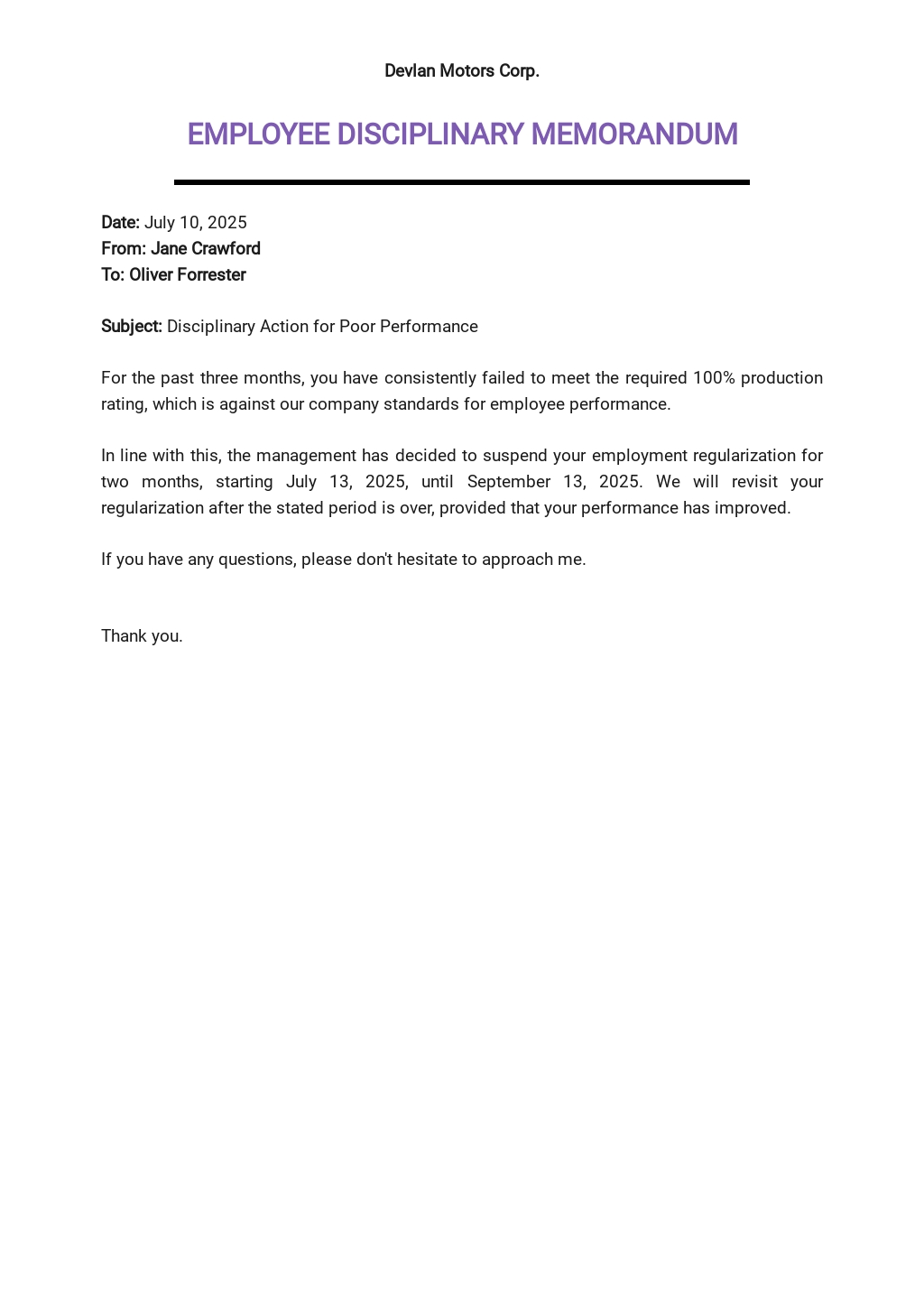 1024×1446 sample employee memo template word templatenet from www.template.net
  945×1241 employee disciplinary form from freewordtemplates.net
  1200×840 disciplinary memo template word apple pages from www.besttemplates.com
  1024×1446 sample memo employees discipline template word from www.template.net